Ask the Pharmacist
Q: Many of us could not wait to be done with 2020 and begin a new year with a fresh outlook. However, I feel as if I am living in the movie “Groundhog Day.” It feels as if I keep reliving the same day over and over again. Why does the second wave of COVID-19 (Coronavirus) seem to be worse than the first?
A: Well, who would have thought that nearly 10 months into this pandemic, we would be in the throes of another lockdown amidst a second wave? Some people, in fact, predicted this and, thus, encouraged politicians to act early to reduce the toll on the hospitals and health-care system.
Despite this, many of us still held onto hope that after a somewhat blissful summer of outdoor activities and patios, which helped us feel “normal,” we would not be needing to close up shop once again. After all, most of us have complied with the mandated mask-wearing indoors, and observed the two-metre social-distancing rule. Yet, the second wave is here and it is worse than the first wave we saw in the spring for many reasons.
The main one is, unfortunately, obvious. Once the cooler temperatures arrived in the fall, more people ventured indoors to dine within restaurants and cafes. Students were sent back to the classrooms, and indoor activities, such as hockey and curling, resumed. Though it was great for our mental health, to get back to socializing and to enjoy a semblance of routine, the decreased social-distancing these activities demand and the shared air, meant that the second wave was almost inevitable.
For those who may not know what a second wave means, it is another increase in infections after the first rise of infections appears to have diminished. During this “lull,” the virus had not been eradicated but case numbers had dropped to such an extent that many felt they could expand their activities and increase social gatherings.
On top of that, quarantine fatigue set in and we began letting our guard down and perhaps not being as strict as we needed to be when it comes to hand-washing or mask-wearing when with others.
As mentioned in previous articles, this is a novel Coronavirus and, thus, we are constantly being updated with new or changing information. For instance, it was initially believed that large droplets of the virus on surfaces were the cause of contamination. That meant you had to touch a surface that had the virus on it, then touch your face or eat without hand-washing. Now, it is believed that just sharing the space with others, particularly in an indoor setting with less ventilation, increases our exposure to the virus.
Because of this, many experts claim that the lockdown occurred too late and allowed for too many gatherings in the weeks prior, causing the caseloads to rise higher than what we are able to handle. The partial lockdowns in Ontario and Quebec did not prove to be entirely effective.
In Ontario, people from the “grey” zones were able to travel to other areas easily. In Quebec, though the restaurants have been closed to indoor dining since Oct. 1, the stores and malls were allowed to remain open for many to share their germs with strangers. Both provinces continued to see a significant rise in cases despite their initial partial measures, leaving us in another lockdown and debating the merits of even more stringent restrictions.
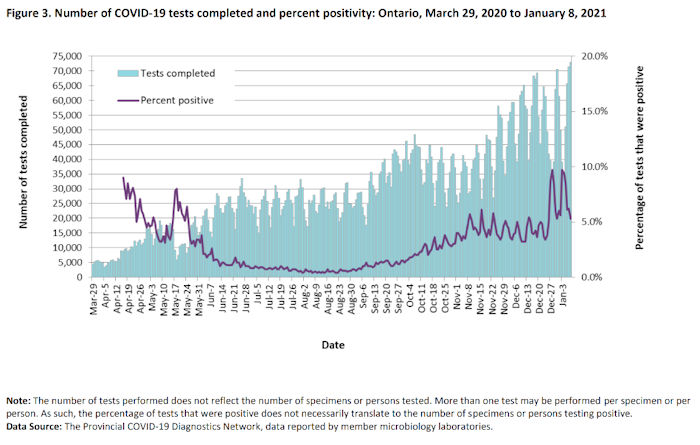
Some people have questioned whether the number of increased cases is just a result of more testing rather than as a result of the second wave being worse. However, higher-volume testing is not just a recent phenomenon. During the summer, when the caseload was low, the restrictions on testing were lifted and pretty much anyone could be tested.
When the schools opened up in September and a negative COVID-19 test was required for anyone and their siblings who experienced any symptom, mild or not, a very high number of tests was being performed daily. The cases did not seem to rise significantly at that time, but rather a few weeks later, indicating that this is all much more than increased vigilance.
The number of cases in Ontario surpassed 2,000 for the first time in October (to think we were shocked at those numbers when we are around 4,000 new cases daily as of Jan. 10). The number of sick people, hospitalizations and sadly, deaths, has also been on the rise, so we cannot blame the increase in testing for these unfortunate events.
Below is a graph from
www.publichealthontario.ca/ showing the number of tests performed against the number of positive results, since the beginning of the pandemic.
One of the reasons that people have become lax on their own personal pandemic protocols, might be due to misunderstanding. Some people enjoy keeping up-to-date with news, including the Coronavirus, through social media and perhaps have been misled. Hopefully, we can all agree that not everything you read on Facebook, for example, is true.
Some of the misinformation that is spreading includes the following:
- This virus is not any worse than the seasonal flu
- This virus will just go away on its own soon
- This virus is being spread as a bio-weapon
- The vaccine will be a method for the government to control us
Such fables have led to fear, anxiety and confusion among many people, leaving them unsure as to whom or what to believe. When in doubt, look at the source of the information. Perhaps look toward articles from leading experts who are researching this disease to keep you updated rather than your well-intentioned neighbour or the current president of the United States.
To reduce your own risk, as has been suggested since the beginning:
- Practise hand hygiene - are you still washing your hands for 20 seconds?
- Try to maintain a two-metre distance with others
- When indoors, open a window for fresh air
- Look to wear a three-ply face mask
Remember, we are all in this together.
​For more information about this or any other health-related questions, contact the pharmacists at Gordon Pharmasave, Your Health and Wellness Destination. Also check the website at www.gordon-pharmasave.com/ and the Facebook page at www.facebook.com/GordonPharmasave/
 Written By
No bio for this author.



Related Stories
No related stories.