Once Upon a Time – A poem to pay for a boat trip
You’ve heard of “singing for your supper?” How about “composing a poem to pay for your boat trip?” One enterprising fellow at the start of the 20th Century proved there was profit in poetry.
In October, 1954, local historian Bruce Krug interviewed Bert MacDonald at Goderich harbour. Bert’s father owned the schooner, “J.G. Kolfage.” For 20 years, she hauled the season's cut of lumber from the McVicar sawmill at Johnston’s Harbour on the Bruce Peninsula, down to Chatham.
For example, April 23, 1903, the Goderich “Signal” reported, “Captain John MacDonald has been waiting for favourable weather since the middle of last week to take out the “Kolfage.” She takes mill supplies to Johnston’s Harbour and loads lumber there for Chatham.”
Bert recalled the time that his father was taking “Kolfage” out of Chatham to pick up another load of lumber. Two men asked if they could ride along on the ship to Johnston's Harbour. His father agreed to give them a ride, and their board, if they would help in loading lumber at their destination.
When the “Kolfage” arrived at Johnston's Harbour, one of the men found that after handling a few boards, he couldn’t do the work. It wasn’t that he was all thumbs, but rather that he lacked thumbs entirely. He begged the captain to excuse him from handling lumber, promising that, in return for his fare, he would write poetry all the way back to Chatham.
Bert MacDonald said that by the time the ship returned to Chatham, the thumbless man, whose name was John McCuish, had written 23 verses. The poem starts, "We shipped on board the “Kolfage” at Chatham County Kent,/The fourth day of October for Johnston's Harbour bent."
Captain John MacDonald took the poem to the Chatham “Planet,” where it was printed. This would be about 1904. The editor of the newspaper said he would like to hire a writer like this, but McCuish disappeared soon after the ship docked in Chatham. People said he’d been on the lam and had travelled on the ship to Johnston's Harbour in order to dodge a police pursuit.
After the poem appeared in the “Planet,” sailors all over the Great Lakes started to recite “A trip on the schooner ‘Kolfage’.” You can read it in the archives at the Bruce County Museum and Cultural Centre. There are two versions, one with 11 stanzas, another with 12.
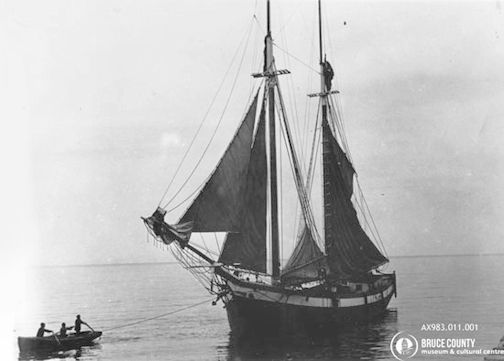 The breeze wanting, the “J.G. Kolfage” is towed into Kincardine harbour by three men in a boat
A TRIP ON THE SCHOONER "KOLFAGE"
By John McCuish
We shipped on board the “Kolfage” at Chatham County Kent,
The fourth day of October for Johnston's Harbour bent.
Commanded by MacDonald who always fast time makes,
On board the Schooner “Kolfage,” Columbia of the Lakes.
The Lake tug “Vick” took us in tow at nine o’clock at night,
And down the Thames we floated ’mid moonbeams sombre light.
And when we reached the Lake St. Clair, the wind was dead ahead
So the captain ordered anchor down and we went off to bed.
Next morning, when we hoisted sail the wind came from the west,
And the “Kolfage” plowed the Lake St. Clair while the water frothed like yeast.
We were heading for the St. Clair cut with all our sails unfurled,
With a bending mast, we certainly smashed the record of the world.
Just then a steamer came abreast and we ran neck and neck
The cut was not far distant and our speed we could not check.
We ran into the steamer to keep her off the bank
The fenders rubbed, both sides we scrubbed, of course we got a yank.
We reached the Town of Sarnia the afternoon that day,
The wind, once more contrary we anchored in the bay.
We were towed out next morning in the lake a mile or so,
With the “Cataract” and “Vianna” from Lake Ontario.
All three then stripped for action for a race it was to be,
For the Lake Ontario clippers claimed the supremacy.
With every stitch of canvass stretched, we ran north like a steer.
And when that night the sun went down, they were hopelessly in the rear.
Next day we reached Southampton and anchored off the shore,
Just inside the harbour while the waves outside did roar
And the good ship Schooner “Fulton” inside the harbour found
In a waterlogged condition and also run aground.
At dawn we raised our anchor, and hoisted sail once more
And headed out into the lake, away from the rocky shore
We then sailed north along the Cape before the southwest breeze
We run her into a little bay among lumber piles and trees.
We hauled in all our canvass and tied up to the dock
And seven men came walking out along the ridge of rock
We then did eat our dinner for we were feeling lank
And shortly got introduced to a 22-foot plank.
But before we started at the plank, oat bags we had to tote
And haul 30 barrels of flour from the bosom of the boat.
We hoisted at the flour till our fingers began to swell
But I’d gladly haul the flour if the planks they were in h——.
So now the boat is loaded and we are on the shore
Resolved to never handle plank or lumber any more
And as the “Kolfage” rounds the bend and disappears from view
Goodbye Captain MacDonald, here’s our respects to you.
 Written By
No bio for this author.




Related Stories
No related stories.