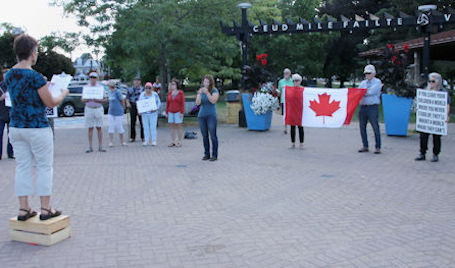
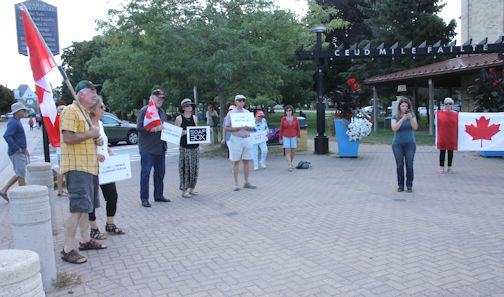
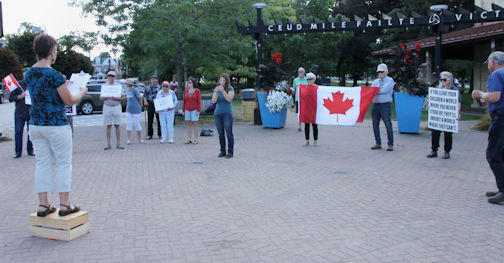
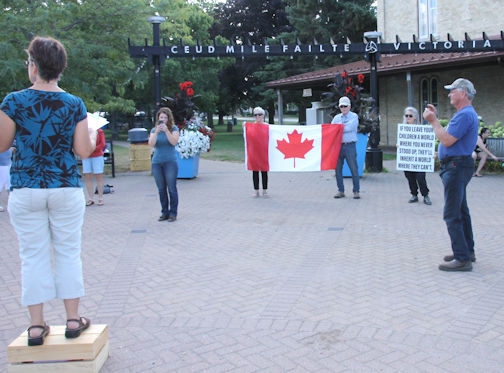
About 50 people gathered at the entrance to Victoria Park, at the corner of Queen Street and Durham Market North, in downtown Kincardine, for a Soap Box Speech about food, farmers and the future, Saturday afternoon, Sept. 10.
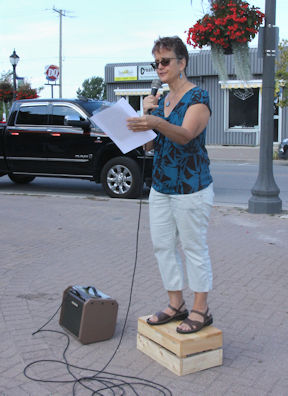
Created by Amanda Doyle, the speech was read by Lisa Thurman (right) of Kincardine.
Referring to “Druthers News, one of the rare newspapers not afraid to print truth so the public can be truly informed," the speech states that the latest headlines talk about our food supply being under attack.
“How far are your dollars going toward groceries today?” states the speech. “While COVID-19 rules have disrupted the whole of the food supply chain, (prime minister) Justin Trudeau says, ‘This is going to be a difficult time because of the WAR, because of the RECOVERY from the pandemic.’ Or could it be because of the mandates and new policies the government implemented over the past couple years?”
The speech notes that the FBI put out a warning in April about increased cyber attacks in 2021 and early 2022 on agricultural institutions, stating they could disrupt grain production and impact the entire food chain.
“Author Michelle Zeh asks the obvious question, ‘Is this a deliberate attempt to sabotage our food supply?’
“The Union Pacific Railway placed a cap on fertilizer shipments in April. Farmers are receiving less fertilizer and now the government is forcing farmers to reduce fertilizer to cut emissions of nitrous oxide, by 30 per cent over eight years, at a time of high inflation and increasing food insecurity. This policy will cost Canadian farmers over $48-billion.”
The speech says that diesel exhaust fluid required by newer diesel machines is also being capped - as if soaring fuel prices weren’t enough.
“So, at previous Soap Boxes, it’s been more about me bringing YOU information,” said Thurman. “Today, let’s have a discussion! Anyone with thoughts on the ‘our food supply is under attack’ headlines? Has anyone noticed any of these things or other happenings that might suggest this?” Several people responded.
Another headline reads, “Food shortages in six months - the globalists are telling us what happens next,” states the speech.
“Well it’s easy to predict a disaster when you create the disaster. The policies of many of the biggest institutions, such as the IMF (International Monetary Fund), the BIS (Bank for International Settlements),World Bank, UN, the Rockefeller Foundation, World Economic Forum, and Bank of America are all predicting a food crisis. And yet it’s the policies, always with a ‘very good sounding’ ideological philosophy behind them, that are causing what they are predicting!
“While the invasion on Ukraine will lead to less food supply, it’s actually the currency devaluation and price inflation created by the central banks pumping out tens of trillions of dollars in stimulus packages to prop up ‘too big to fail’ corporate partners that has really done the most damage.
“In 2020 alone, the Feds created over $6-trillion from nothing and air-dropped it into the economy through COVID-19 welfare programs. Add that to the many trillions the Feds printed since the credit crash in 2008 - it has been a non-stop dollar destruction party and now the public is starting to feel the consequences.”
The speech states that inflation leads to government price controls, price control leads to lack of profits, lack of profits leads to loss of production, loss of production leads to shortages, and shortages lead to government rationing (control over all large food sources).
“When a government controls the food, it controls the population,” states the speech. “Could this be the plan?”
About 50 people gather for the Soap Box Speech in Kincardine, Saturday afternoon, Sept. 10
The final headline was, “The Dutch Farmers' Protest and the War on Food,” referring to tens of thousands of farmers gathered all across the Netherlands to protest the government policies which will reduce the number of livestock in the country by up to one-third. This will indeed shrink the whole farming sector, impacting thousands of farmers and the food supply of literally hundreds of millions of people.
The article concludes, “If the collective governments of the Western World were trying to impoverish and starve their own citizens, what exactly would they be doing differently?”
“Well there’s always hope,” said Thurman. “These policies force us to use our God-given creativity and re-think the way we do things. What are some ways you can think of that will help our food supply for the future?”
Several members of the crowd suggested planting a garden in your backyard, buying local produce, supporting food programs and community gardens.
“While I’m not a farmer, I know a few who are thinking ahead and practising more sustainable, less dependent kinds of farming,” said Thurman. “One farmer gave me some ideas he sees are the ways of the future, such as small-scale farms sharing farm equipment; using fertilizer only at critical times for growing at planting and flowering time; more pasture-based livestock based operations - with this kind of farming you don’t have to plow or till as much soil, and we have lots of land that can be grazed!
“Regenerative farming doesn’t require synthetic fertilizers or pesticides as its focus is on using interactions among soils, plants, water and animals to restore. Learning about and investing in sustainable soil health and planting a bigger variety of crops are great solutions.
“So what if you’re not a farmer?
“Well, buy directly from one and pre-order meat. Buy shares in a Community Supported Agriculture or CSA program. Buy and keep extra non-perishables. Build relationships and networks with like-minded people - the Soap Box is a great place to do that!”
The speech urges the public to petition the government:
To reduce trade barriers and export restrictions.
To motivate farmers to find ways to increase output to meet global demand more gradually rather than cutting off supplies they’ve depended on for years so quickly.
Lisa Thurman (left) of Kincardine gives the Soap Box Speech in Kincardine



 September 17, 2022
1577
 About 50 people gathered at the entrance to Victoria Park, at the corner of Queen Street and Durham Market North, in downtown Kincardine, for a Soap Box Speech about food, farmers and the future, Saturday afternoon, Sept. 10.
Related Stories
No related stories.