Vision-screening begins for Senior Kindergarten students at Bluewater District schools
Vision-screening begins this month for Senior Kindergarten students at schools with the Bluewater District School Board.
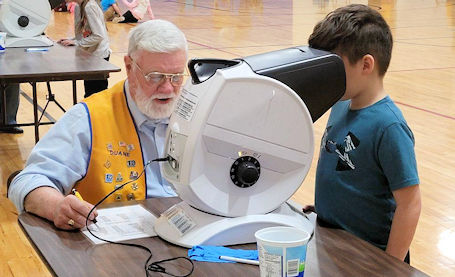
Grey Bruce Public Health, in collaboration with Lions Club volunteers, will begin conducting publicly-funded vision-screenings at these schools, after successfully launching the in-school program at schools with the Bruce-Grey Catholic District School Board in the fall.
The program involves Senior Kindergarten students completing three simple, non-invasive tests, designed to help identify the most common vision impairments in young children. Trained volunteers with District A-9 Lions Clubs will conduct the tests, overseen by public health.
“Thanks to our partnerships with the local Lions and the Catholic school board, we were able to successfully screen Senior Kindergarten students at all 10 Catholic elementary schools this fall,” says Chimere Okoronkwo, senior public health manager.
“We are now gearing up to bring this service to Bluewater schools, with a plan to see nearly 1,300 Senior Kindergarten students between the last week of March and mid-May.”
Parent/guardian letters will be sent home with these students before the clinic dates at their school. The screening, which will take place during the school day, helps to identify vision impairments, such as Amblyopia (sometimes called “lazy eye”), Reduced Stereopsis (inability to recognize depth), Strabismus (more commonly known as “eye turn”), and Refractive Vision Disorder (such as nearsightedness, farsightedness, and astigmatism).
About 80 per cent of what a child learns in school is information that is
presented visually, according to the Canadian Association of Optometrists. However, vision problems may go undetected in early childhood because children cannot always recognize that they have vision problems.
Early identification and treatment of vision conditions that can have few or no visible symptoms, can play a significant role in healthy childhood development.
Screening results will be sent home with students in a letter that also encourages families to contact an optometrist about booking a routine, comprehensive eye examination for their child.
The in-school vision-screening is not meant to replace annual comprehensive eye exams with an optometrist, and is not designed to detect all vision problems.
The Canadian Association of Optometrists recommends that children undergo at least
one eye examination between the ages of two and five and that children, aged five to 19, receive an eye exam annually. In Ontario, yearly eye exams are
covered by OHIP until a person turns 20 years old.
The Ontario Public Health Standards provides a
mandate for public health units in Ontario to develop visual health programs and services.
 Written By
No bio for this author.



Related Stories
No related stories.