Former Kincardine man tells of difficulty getting out of Sudan after fighting began
Tim Sanborn of Cochrane, Alberta, and formerly of Kincardine, was working in Sudan, in northeast Africa, when fighting broke out between the army and the paramilitary Rapid Support Forces.
The 51-year-old was lucky to get of the country and back to Canada.
Born in Southampton, Sanborn lived in Kincardine from early childhood to adulthood, with the exception of two-and-a-half years when his family lived in South Korea. He went to W.E. Thompson Public School and Kincardine District Secondary School.
His parents, John and Karen Sanborn, still live in Kincardine, and his sister, Karlee, lives in Ayr, Ontario.
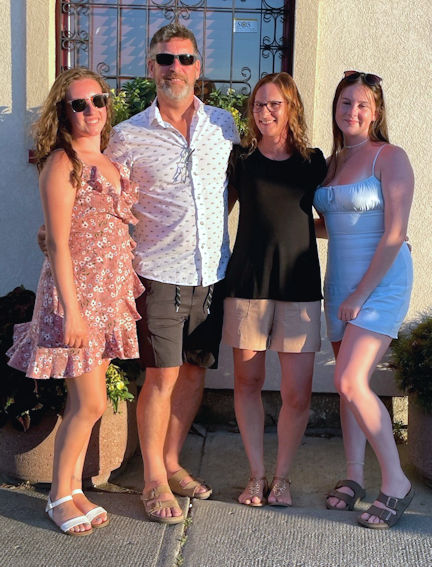
Sanborn has lived in Alberta for 26 years, and Cochrane for 21 years. He and his wife, Nycole, have two daughters, Jillian, 21, and Jessica, 19.
He works for Hunterwood Technologies, a company that manufactures, installs, commissions and services agricultural equipment all over the world which is why he was in Sudan.
“I went there to commission one of our forage compactors in a city called Abu Hamad, 550 kilometres north of Khartoum,” says Sanborn. “I left Calgary, April 1, and was scheduled to be in Sudan until late April.”
He was on-site in Abu Hamad from April 3-14, and returned to Khartoum, April 14.
“I was scheduled to fly home April 17, but the fighting broke out on the morning of April 15, less than one kilometre from my hotel, which was right beside the Khartoum airport.
“By the afternoon of April 15, it became very apparent that I would not be flying home as scheduled. The airport had become ground-zero for the conflict and it was heavily damaged, and obviously, was an extremely dangerous area. I knew that getting out of Sudan was going to be very difficult and likely dangerous.”
Sanborn spent five days in the Kanon Hotel, next to the airport, and food, water and diesel for the generator, began to run out.
“There were armed soldiers and artillery on the street outside of the hotel, and the supermarket across the street was broken into and looted,” he says. “I was worried that our hotel might be next. The company I was working for in Sudan arranged to have me moved to a second hotel, the Al Salam, which was still close to the airport, unfortunately, but did have more supplies and there were expatriates staying there as well.
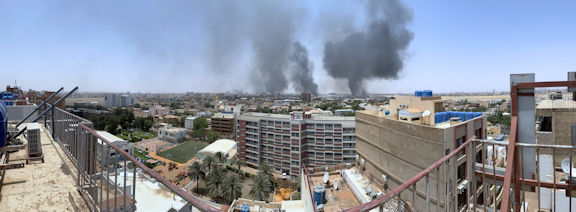 View of the fighting from the Kanon Hotel, April 15; photos courtesy of Tim Sanborn
“At the Kanon Hotel, no one else spoke English and it was very isolating. The move to the Al Salam was made in an old van with a couple of local guys navigating through the contested areas, trying to avoid the shooting, and passing through numerous military checkpoints.
“I spent another five days at the Al Salam while I worked on an exit plan. The fighting was still very close and the sound of gunfire and heavy artillery was almost constant. Finally, Tuesday, April 25, I was able to board a bus going to Port Sudan, which was 840 kilometres from Khartoum. This bus was arranged by our evacuation insurance company and was part of an evacuation convoy.”
Sanborn said it was extremely difficult to make arrangements for safe evacuation.
“The van ride to the second hotel was terrifying and very risky,” he says. “We lost both cell service and the Internet for a few days and communication with both the evacuation company and my family was impossible.
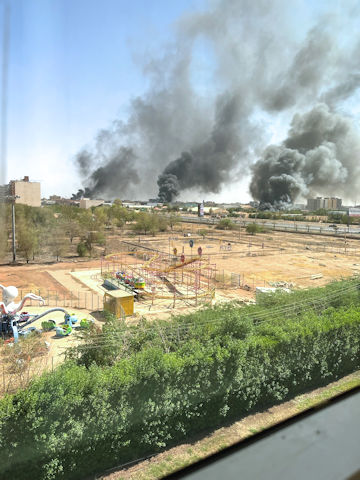
View from the second hotel, Al Salam, south of the airport
“The ceasefires were largely ignored by both warring parties, and it was never completely safe to move by land or air. The bus ride to Port Sudan took 15 hours and went through areas where there was active fighting, and we had to pass through many checkpoints with armed soldiers boarding the bus every time.”
Once Sanborn and his fellow passengers arrived in Port Sudan, they had to submit their passports to the Saudi military which was co-ordinating the evacuation to Jeddah, Saudi Arabia.
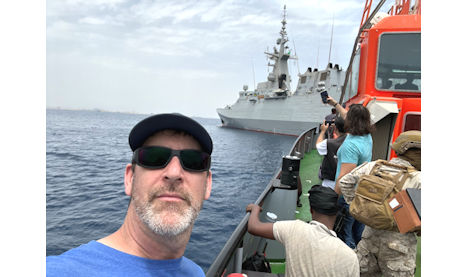
“We spent a very stressful night in a refugee camp waiting to hear whether we were selected for a spot on the evacuation ship,” he says. “Finally, after waiting for 18 hours, 55 of us were loaded on a tug boat and we sailed to open water where we were then loaded on a Saudi warship, the "HMS Al Jubail."
“We received a very warm welcome once we were on the ship, with a banquet with the captain and crew. We received three full meals and finally had a place to lie down and sleep.
“Around 21 hours later, at 8 a.m., April 28, we arrived in Jeddah, Saudi Arabia, and again received a hero's welcome from the Saudis. There were many TV cameras and dignitaries at the port and we were given Saudi flags, chocolates, etc., upon arrival.”
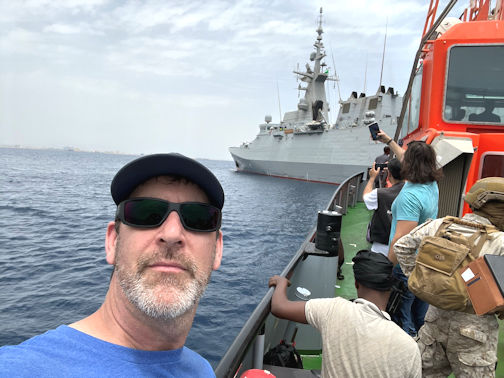 Tim Sanborn boards the Saudi warship
Sanborn went through Saudi customs and stayed in Jeddah for one night before flying home through Dubai, Toronto and then Calgary.
Meanwhile, back in Cochrane, his wife and daughters were frantic.
“My family was very worried, especially when I was unable to communicate with them for extended periods of time,” says Sanborn. “It was a constant battle to keep phones charged, have the correct SIM cards, and send messages when the system allowed.
“There were many highs and lows, times when I thought I was safe, only to suffer a setback and have evacuation plans cancelled, or have the fighting increase in intensity when a ceasefire was expected. Our family received tremendous support from friends and family, and it was a great distraction for me to hear from people back home.”
Sanborn has been home for a week and is enjoying some time off, visiting with friends, and having the whole family back together under one roof.
When asked about future travel plans, he says he isn’t travelling very far from home for awhile.
“I plan to come back to Kincardine for a visit in the next month or so, as I have many friends and family to thank in person,” he says.
“I do think it’s important to mention the friends I made in Sudan who helped me get out of danger, and I worry about their future in that country. The Sudanese people are some of the nicest people in the world, and do not deserve to have to suffer through this. Sudan needs help from the rest of the world to stop the fighting and rebuild their country.
“The people there are extremely resilient, brave and generous. I learned a lot from them and hope to be able to help them recover from this tragedy.”
Tim Sanborn (second from left), with his family, Jillian (left), Nycole and Jessica
 Written By
Liz Dadson is the founder and editor of the Kincardine Record and has been in the news business since 1986.



Related Stories
No related stories.