Bruce County Memories: Farmerettes were the unsung heroes of the home front
It was 1940, a time of national emergency. At the start of the Second World War, Hitler’s army ruthlessly swept across western Europe. Britain suffered devastating bombing raids and food shortages due to German blockades.
Canadian farms would have to supply hundreds of thousands of tons of food to feed the troops and the starving people of Europe. Yet with the men from the farms joining the fight overseas who was going to harvest the crops?
Ontario’s solution to the acute labour shortage was to call on teenage girls to join the Farmerette program (officially, the Ontario Farm Service Force).
Advertisements spread the word about how girls, age 16 and older, could “lend a hand” in the war effort by spending their summer holiday working on vegetable and fruit farms in southwest Ontario.
 Advertisement from the Farm Service Force: “Ontario farmers need your help”
And the young women responded enthusiastically — over the life of the program, 40,000 signed on to be a farmerette. (It didn’t hurt that they could get out of doing their final exams, and get paid at the going rate.)
They came from different parts of Ontario and Quebec. Some girls from Quebec rode their bicycles to the Niagara region just so they could lend a hand.
Most of the girls came from urban areas and had no farming experience, but quickly showed they were capable. They stayed in work camps which the Ontario Farm Service Force had set up across southwest Ontario. Each day, farmers would come to recruit workers.
The “Hamilton Spectator” of June 14, 1941, had six photos captioned, “Girls to do their bit to win war by aiding Niagara District Farmers.” One photo shows a converted horse barn “fixed up to house 60 girls from Hamilton, Wiarton, Owen Sound, Walkerton and Milton.” It mentions two girls from Wiarton, Shirley Fatum and Nadine Yager.
For months, the farmerettes worked long days in market gardens, orchards and canneries. They planted, hoed, hand-weeded, thinned, staked, picked fruit and harvested vegetables.
After gruelling days in the fields, they hitchhiked to dances, went on hayrides, roller-skated or swam in the lake. Some ended up meeting their future husbands. Others had eye-opening experiences, such as working in the fields alongside German prisoners of war.
At war’s end, the Farm Service program had been so successful that it was continued. But by 1952, the arrival of post-war refugees and immigrants, combined with farm mechanization, made the program unnecessary.

In 2019, author and photographer
Bonnie Sitter (right) of Exeter, was going over old family photographs and was intrigued by one small photo of a group of smiling women on the running board of a truck inscribed, “Farmerettes 1946.”
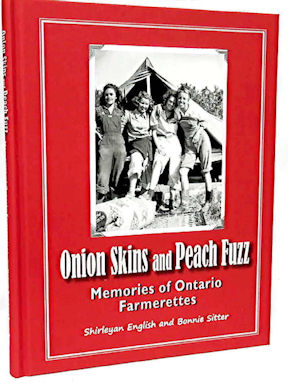
The image sparked a desire to know more about “farmerettes.” She collaborated with Shirleyan English — herself a postwar-era farmerette — to tell their story, in the book,
“Onion Skins and Peach Fuzz: Memories of Ontario Farmerettes.” (below)
Filmmaker and musician Colin Field was attending the Celtic Roots Festival in Goderich when he met Sitter and learned about the farmerettes. They resolved to join forces to work on a documentary based on the book.
In an interview with “Legion Magazine” in May, 2025, Field said his goal as director of the 50-minute film, “We Lend a Hand: The Forgotten Story of Ontario Farmerettes,” was to tell the story through the surviving farmerettes’ own experiences. He interviewed 20 farmerettes who are still alive, some of them over the age of 100 now.
“We Lend a Hand” premiered in April, 2025, at the Junction North International Documentary Film Festival in Sudbury. The movie trailer is at
welendahand.ca.
After sold-out showings across southern Ontario, “We Lend a Hand” came to the Bruce County Museum Theatre in Southampton, Aug. 20. The Bruce County Historical Society hosted two sold-out screenings as fund-raisers for the film-makers.
 Poster for “We Lend a Hand”
Sitter continued pushing for greater recognition for farmerettes. She lobbied for, and obtained, a Canada Post stamp, issued in 2024. It’s titled, “Taking a break from hoeing celery, Thedford, Ontario, 1945.”
 Bonnie Sitter lobbied for a Canada Post stamp, issued in 2024; the photo from 1945 is titled, “Taking a break from hoeing celery”
Coming up next month, Oct. 25, author Kent Kraemer takes us back to the First World War and the exploits of the 160th Battalion from Bruce County. He will speak at the annual meeting of the Bruce County Historical Society, at the Lucknow Legion, 477 Inglis Street, Lucknow. Buy your tickets ($30 each, with dinner at noon) by Oct. 9 by sending an E-mail to
bchsregister@gmail.com or calling 519-368-7186. Details are at the historical society’s website,
www.brucecountyhistory.on.ca and Facebook page.
 Written By
No bio for this author.




Related Stories
No related stories.