NIMBY: Nature in My Back Yard - A weed by any other name
As we enter the month of February and the horticultural industry gears up for massive sales of flowers, I’m reminded of the oft-quoted lines from Shakespeare’s "Romeo and Juliet": “…
What's in a name? That which we call a rose / By any other name would smell as sweet…”
Sadly, a number of native plants that provide crucial environmental support are stigmatized by having "weed" in their name. This month I’d like to spotlight a few and show them a little love.
Generally speaking, a weed is any plant growing where it’s not wanted.
In agriculture, weeds may have negative impacts on crop yields because they compete for nutrients, water and space, add expense and effort to control, and in some cases, are injurious to livestock. Consider the difficulty settlers of North America would have had dealing with so many unfamiliar plants and working so hard to grow crops just to survive. It’s understandable that if they couldn’t identify a use for a plant or if it seemed to create a problem, it might get lumped into a category of “other.” Consequently, many beneficial native plants have been termed weeds.
The common name given to these misunderstood beauties may refer to the appearance, the behaviour or the traditional use of the plant. Let’s consider a few of the better known species.
 Milkweed
 gets its name from the thick, white sap that oozes from the plant when the stem or leaves are broken. The sap contains toxins that are harmful to people and animals and until 2014, it was listed in Ontario as a noxious weed. However, it is the sole host plant for Monarch butterflies and provides food and habitat for many other insects. It’s also referred to as silkweed due to the fluffy down which was used in life preservers in the Second World War and currently, is used as stuffing for pillows, comforters and outerwear as a sustainable alternative to down.
The flowers are complex and beautiful if you take the time to examine them; photos by Christine Roberts
There are a dozen or so species of milkweed native to Ontario. The three most common are Common Milkweed, Swamp Milkweed and Butterfly Weed. They thrive in diverse environments and are an essential plant in any habitat garden.
Take the time to look closely at a milkweed plant in bloom and marvel at its beauty. The flowers are complex and grow in clusters or umbels. Depending on the species, the clusters are spherical or flat-topped. The individual flowers are formed of five petals that fold back. In the centre of each is a five-part corona with five hood-like structures, each containing a small protrusion or horn.
Of the three common varieties,
Butterfly Weed is well-suited to inclusion in ornamental flower beds. Its bright orange blooms are attractive, it’s a relatively short plant growing in clumps and is very drought-tolerant, once established.
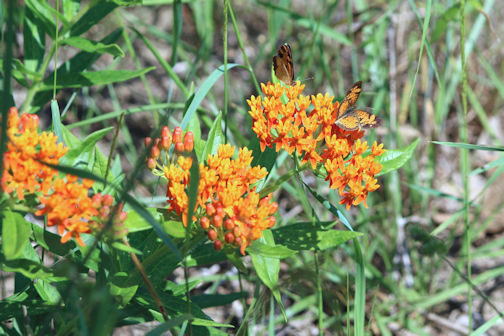 This bright orange native plant fits well in any sunny flower bed and will attract many insects

Swamp Milkweed is an insect magnet growing two to five feet tall with pleasantly fragrant pink, purple or white flowers. It’s less aggressive than Common Milkweed with a clumping habit and flourishes in moist conditions but is adaptable. Anecdotally, in our experience, the presence of Swamp Milkweed almost guarantees Monarch butterflies.
Swamp Milkweed comes in pink, purple and white and all varieties are irresistible to Monarch butterflies
Joe Pye Weed is reportedly named after an 18th Century Indigenous healer, often identified as a Mohican named Joseph Shauquethqueat of New England who used the plant to treat typhus and other fevers. Some sources also suggest "Joe Pye" may be an anglicized version of a native term, such as "jopi" or "jopai," which were terms used for typhus.
It’s a tall plant (three to 10 feet) with large clusters of small, fluffy pinkish-purple florets appearing in late summer. It’s also an insect magnet and host plant and a great companion to Swamp Milkweed as it prefers moist conditions and blooms a little later. There are three species of the plant native to Ontario.
is another tall (two to eight feet), moisture-loving native plant. It’s speculated that it derives its name from the fact that the stems are very rigid and hard to break and the seed heads turn a rusty colour as they mature.
 A tall, moisture-loving plant with vibrant colour and great attractiveness to insects and birds
This plant boasts clusters of fuzzy, vibrant purple flower heads in late summer and is another pollinator powerhouse, providing food for insects and birds, and is host to many butterfly and moth species.
There are many other native “weed” plants, such as Silverweed, Jewelweed, Fireweed, Pokeweed and Pickerel Weed but I’ll end with my personal favourite, Sneezeweed.

You might find
Sneezeweed at a garden centre with the name Helen’s Flower or Helenium. It’s thought to have been named for Helen of Troy and the legend that flowers sprang from the ground where her tears fell.
A member of the aster family, it grows to a medium height and blooms in late summer and fall. It has masses of cheerful daisy-like flowers with a ball in the centre. It is another insect magnet and host plant to several species of moths.
Sneezeweed adds beautiful colour and provides a vital food source for insects in the fall
This plant is one of my favourites because its beautiful flowers brighten my gardens in fall as many other plants have finished blooming, it attracts many pollinators, and I love the name.
No need to worry about allergies or sneezing. The common name comes from its ancient use as snuff. Indigenous peoples and early settlers dried leaves and flower heads which were crushed into a powder and inhaled to cause sneezing. This was thought to expel evil spirits and relieve nasal congestion and pressure.
The term “to grow like a weed” implies rapid, perhaps aggressive, growth. I know that many native wildflowers tend to be tall and pose design challenges for smaller urban gardens. However, these plants are essential food sources for many insects and birds. Recognizing the growing desire to support the environment and its smallest creatures, the horticultural trade is developing nativar varieties that combine the ecological benefits of food and host sources with shorter size to accommodate home gardens.
I hope you’ll consider including some of the weeds I’ve highlighted, in your gardens in the coming growing season. Perhaps in a future column we’ll look at another group of unfortunately-termed native plants: those with “wort” in the name.
 Written By
Christine Roberts is a retired elementary school teacher, president of Huron Bruce Nature, member of the Ripley and District Horticultural Society, volunteer for the David Suzuki Foundation, VON volunteer fitness leader and a passionate lover of nature.




Related Stories
No related stories.