



 October 16, 2026
60
October 16, 2026
60

By Don Leatham
As the youngest of a family of five boys and two girls, I experienced most farm activities at an early age. I can remember sitting on my father’s knee at five or six years of age, steering our little Ford tractor as we came back from the field. I can also remember driving it when I was still so young that I had to leave the seat to reach the clutch pedal.
Now, before you get too excited about safety concerns, it is well to remember that the fastest of the three forward gears in that old grey Ford could only generate a top speed of about 10 miles an hour, and the tractor’s size would not exceed, by a great deal, the larger garden tractors you see today.
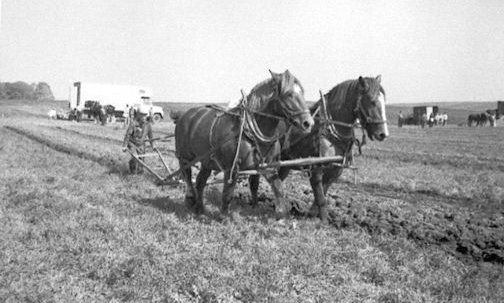
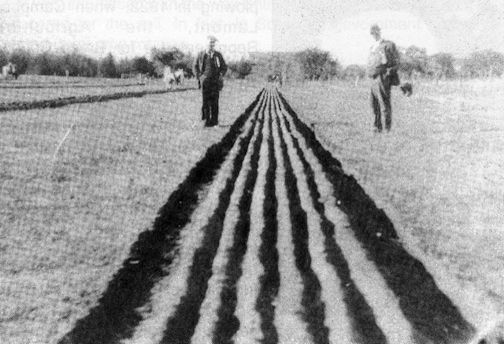
As for learning to plow — that was a skill that wasn’t developed until much later. Dad wasn’t about to allow this important activity to be handled by rank amateurs. If the finishes were uneven, or the sod wasn’t uniformly turned over, the picture remained in his eye and the eye of his neighbours all the way to the next spring. Therefore, instructional sessions and general apprenticing was done in fields well away from the road and the common view. Dad also believed that it was necessary to carefully step off the five- or six-rod-wide lands and to place stakes at each end to see that the field would be properly struck out and each finished furrow straight and true.
My brothers and I tended to take a little more cavalier approach to the task. Instead of carefully setting out stakes as markers, we simply counted the fence posts and used the matching one at the other end of the field as our target. This worked fine as long as you didn’t have to look back to adjust the plow. When this occurred, it was sometimes hard to remember which post you had chosen when you looked ahead again. The result was sometimes disastrous. Instead of a nice straight line to finish, you would end up with a pie shape that took about four or five extra passes to complete and the final furrow would look like something even a snake would have trouble following. It also took some pretty inventive explaining to satisfy the questions put forth by the upper management team as to why the extra trips down the field had been necessary.
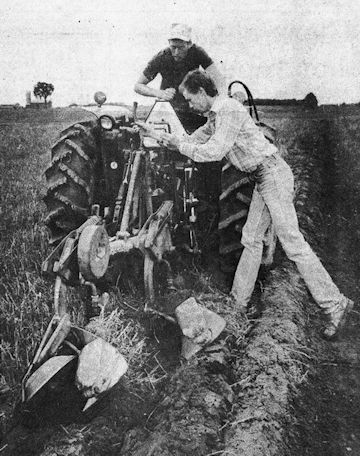
I was guilty of producing my share of pie-shaped finishes, but it was the equipment that I was given to plow with that really enlarged my vocabulary. By the time I was into my teen years, one of my brothers had purchased a farm down the road. Our little Ford had a two-furrow plow that was attached directly to the hydraulic lift and was relatively simple to manage. The raising, lowering and depth adjustment of the plow was controlled by one simple lever. You simply slipped the front wheel of the tractor into the furrow at the headland scratch, engaged the plow and went merrily on your way.
My brother’s tractor and plow were another story entirely. The tractor was an ancient John Deere started by a large flywheel. It was so noisy that you could hear it putting well into the next township. The plow was a pull type with a very touchy trip mechanism. If you didn’t pull the cord exactly right, it would trip the plow either too soon, too late or not at all. All of the above meant you had to circle around and enter the furrow again and start over.
The biggest irritation, however, was the play in the tractor’s steering. Our soil tended toward a heavy, clay loam which meant in a dry fall you had to constantly adjust the levers to keep the plow in the soil at a proper depth. This meant a fair amount of driving south while facing north. This was generally accomplished by placing the front wheel of the tractor that was following the furrow firmly against the sod edge and holding it there by pressing your knee, or whatever other body part was available, firmly against the steering wheel.
In theory, this was a workable system. However, with that old John Deere, it left something to be desired. Invariably, if you took too long making lever adjustments, the front wheel, because of the loose steering, would have jumped out of the furrow and by the time you looked ahead, you would be travelling due west instead of south. This meant that the plow had to be tripped and you had to circle back and start again. As I mentioned, it tended to be a great vocabulary enhancer.
My most embarrassing plowing moment, however, came while I was attending Listowel District Secondary School. At that time, the school had a Grade 10 agricultural course, which included managing a five-acre vegetable plot, situated adjacent to the school, that supplied fresh produce to the cafeteria. Because of the nature of the crop, a small Farmall RowCrop Tractor, with the traditional narrow front wheels set right under the front of the engine, was used. It travelled the rows quite well but needed the firm application of the back wheel brake when turning because of the limited turning traction provided by the narrow front wheel set-up.
During the final day’s clean-up in my Grade 10 year, we all took turns plowing the lot. Although I had never driven a RowCrop model, I managed my first two rounds without difficulty. However, as I came to the headland on my third trip, I lifted the plow but forgot to engage the brake as I attempted my turn and ran smack dab into the wooden sign that advertised the garden. All of my buddies, especially the townies, thought the situation hilarious. It didn’t do much, however, for my dignity, the school sign or my agricultural mark.
Now as I look back, plowing, like many of the farm activities that I engaged in, produced a definite sense of accomplishment. Despite the snow squalls and rain showers we faced in late October and early November (remember, nobody had even thought of a heated cab for a tractor in those days), when you finished a day of plowing you could look back and see what you had done with pride. This feeling was one that I noted all too rarely in my days in the classroom.
****
Don Leatham, a retired elementary school principal, contributed this story to the 2009 Yearbook of the Bruce County Historical Society.
****
Want more farming stories? You’ll love the historical society’s latest book, “Furrows of Bruce County: A harvest of stories from the farm.” Contact book sales director, Bill Stewart (willstew@bmts.com). Or visit these fine bookstores: Bruce County Museum in Southampton, Treasure Chest Museum in Paisley, Holst Office Supplies in Walkerton, Bruce County Bookstore in Cargill, Little Blue House Café/Gallery in Tiverton, Hamilton's Toys and More in Kincardine, Treats and Tales in Kincardine, Berford Street Books in Wiarton, Shops at 84 Main in Lion's Head, or Readers' Haven Book Store in Tobermory.


Related Stories
No related stories.