



 November 1, 2026
129
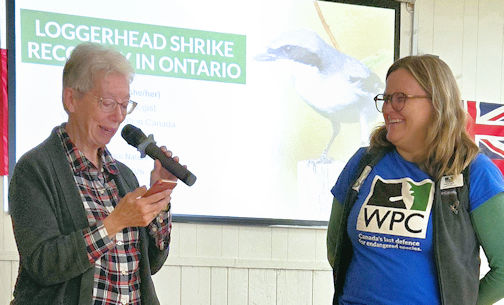
 Guest speaker Helmi Hess (right) spoke to a full house of Huron Bruce Nature members during the meeting Tuesday, Oct. 27, at the Point Clark Community Centre.
A recovery biologist for Wildlife Preservation Canada (WPC), her presentation was titled “Loggerhead Shrike: On the Brink of Disappearance in Ontario.”
Hess began by describing the shrike as a predatory songbird that eats large insects, mice, reptiles, and even other small birds. Because it lacks raptor talons to tear apart food, a shrike will impale prey on sharp thorns or barbed wire. This holds the food steady so the shrike can rip it apart with its hooked beak. Because of this unique technique the shrike is known as the “butcher bird.”
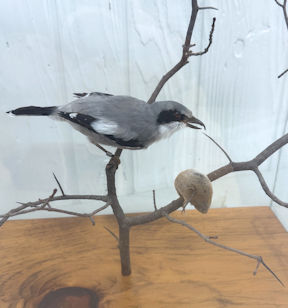
A taxidermy display of a shrike and a mouse (left)
Hess explained that the Eastern Loggerhead Shrike is one of Canada's most endangered songbirds, with only a small number of wild breeding pairs remaining in Ontario. Shrikes are found almost exclusively in two primary grassland and alvar eco-systems in southern Ontario: the Carden Alvar (north of Lindsay) and the Napanee Limestone Plain (in eastern Ontario), with occasional sightings in Grey and Bruce counties or Manitoulin Island. Alvars, themselves, are a globally-rare eco-system consisting of a limestone plain with thin soil and sparse grassland vegetation. In addition to habitat loss, other pressures on shrike population include pesticides, predation and climate change.
WPC leads recovery efforts for these birds, and Hess detailed the organization's efforts and successes. It has a captive breeding initiative which has released more than 1,500 shrikes into Ontario’s wild habitats since 2001. Before young birds are freed into the wild, they are moved to large outdoor field enclosures in Carden and Napanee. This gives them a safe place to hone their hunting skills, and acclimatize. Bird-banding and telemetry are used to monitor wild populations and study the dangers they face along the migratory paths to the southeastern United States.
Hess concluded her presentation with suggestions on what we can do to help the endangered shrike, such as advocating for the environment, reporting sightings, and donating to WPC. Helmi can be reached at h.hess@wildlifepreservation.ca.
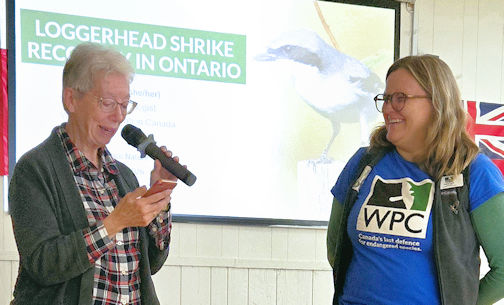
Huron Bruce Nature member Jayne Miltenburg (left) thanks Helmi Hess for her presentation at the club's meeting, Tuesday, Oct. 27, at the Point Clark Community Centre
In other club news, president Catherine Hodges introduced Project Bird Box, a fund-raising initiative to help cavity-nesting birds find habitat. Members and guests signed up to order the solid Canadian hardwood boxes, to be built by board member Brent Bowyer and his team. The sign-up will continue for the next few meetings.
Members were encouraged to “leave the leaves,” as fallen leaves provide nutrients for the soil and habitat for insects and invertebrates.
A leisurely hike in Inverhuron Provincial Park was announced for convener Sue Greco.
The final meeting of the year is Members Night, Nov. 24, and features presentations by three members, a door prize, and a winter-sowing display by Christine Roberts. Doors open at the Point Clark Community Centre at 7 p.m. Guests and visitors are always welcome, refreshments are provided but bring a mug and napkin.
Contact information for inquiries can be found on the club webpage at hbn.huronstewardship.ca, or by leaving a message on the club's Facebook page at www.facebook.com/HuronBruceNature.
Related Stories
No related stories.