


 June 15, 2016
1720

Q: What can you tell me about the new patch designed to treat psoriasis?
A: Those who suffer from psoriasis can attest to how frustrating this chronic skin condition can be. To the public, it is simply an unsightly, scaly skin condition, but for those who suffer from it, it can be a life-long affliction that is often painful and intensely itchy, and appears to ebb and flare for no apparent reason.
For many, psoriasis can lead to a significant increase in sick days, challenge feelings of self-worth, and greatly reduce social interaction with their peers. At present, like so many other disorders, there is no cure for it so the best that we can do is try and reduce the frequency and the severity of the break-outs.
Any person can get psoriasis, regardless of age, although it is most likely to appear in your 20s or 50s. It is estimated to affect about three per cent of the world’s population, with the incidence slightly lower here in Canada and the United States, at two per cent. This means that as many as one-million Canadians struggle with this disorder currently.
There are five official types of psoriasis: plaque, guttate, inverse, pustular and erythrodermic. Of these, plaque psoriasis (also known as psoriasis vulgaris) is by far the most common type, accounting for about 80 per cent of the cases. It tends to appear as raised, red patches covered with a silvery white buildup of dead skin or scale. The patches tend to have well-defined edges and are most commonly found on the scalp, lower back, face, outside of the knees and elbows, the palms and soles of the feet.
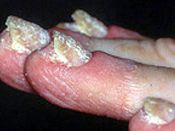 That being said, these scaly patches can be found almost anywhere including the genitals or even the inside of your mouth. About 40 per cent of people with plaque psoriasis have nails that are affected with either a thickening of the nail, nails turning yellowish/brown, or the entire nail lifting up off the skin.
Plaque psoriasis, like all types of psoriasis, is an inherited inflammatory disease caused by a dysfunction of the immune system, making it yet another of the many autoimmune disorders (i.e. rheumatoid arthritis, lupus, etc.). Diagnosis is usually based upon the distinctive appearance and location of the lesions, but a biopsy is sometimes performed if there is some doubt.
As we mentioned earlier, psoriasis is not curable so treatment is aimed at controlling flare-ups and enhancing a patient’s sense of well-being. If the affected area is just a few spots here and there, treatment often involves one of the many creams applied when needed only to the affected area. If large areas of the body are affected, there are systemic treatments that can be undertaken but they do come with more risk of adverse effects and a higher price tag.
Traditional treatment options include corticosteroid creams and ointments (which are known as topical), Vitamin D3 topicals (such as Dovonex and Silkis), Tazorac gel or cream, the calcineurin inhibitor topicals (Elidel and Protopic), assorted coal tar formulations, as well as the more systemic therapies such as tablets containing methotrexate, cyclosporine, Soriatane and injected biologics such as Stelara, Enbrel, Humira and Remicade.
The newest treatment option is Beteflam, the first patch form of the corticosteroid betamethasone valerate (which is the active ingredient in such mainstays as Ectosone and Betaderm creams). It has been approved to treat plaque psoriasis of a mild-to-moderate nature on the elbows or knees of adults.
By putting the medication into a patch, the absorption of the steroid ingredient is enhanced relative to a cream form and, as such, the patch form has been proven more effective at clearing plaques than its cream relatives. It need only be applied once daily (as opposed to twice a day for Betaderm) and up to five patches can be worn simultaneously to treat various areas of the body.
The patch can be cut to the desired size and the unused portion may be saved for later use with proper storage. The patch should be removed if entering water, so it is best applied after bathing or a swim. Ideally, the patch should be kept on for at least 20 hours continuously for best results.
As always, these benefits come with a price tag. A box of 16 Beteflam patches (7.5 centimetres X 10 centimetres) will cost about $55 as compared to about $6 for two ounces (60 grams) of Betaderm cream. For those with drug plans who prize the convenience, lack of mess (creams can rub off on clothes or bedding) and increased effectiveness, Beteflam provides a viable alternative to the many creams patients have been applying for years. For those who have to pay for it themselves, we would suggest the advantages do not justify the hit to the credit card.
For more information about this or any other medical questions, contact the pharmacists at Gordon Pharmasave, Your Health and Wellness Destination.
Related Stories
No related stories.