Lots of issues surrounding the Great Lakes, says advisor
There are lots of issues surrounding the Great Lakes, and plenty is being done to address these issues.

That's the word from
Ted Briggs (right), Great Lakes advisor with the Ontario Ministry of Environment and Climate Change.
Speaking to about 50 people at the third annual Water Stewardship Day, held Saturday in Point Clark, Briggs said he is one of four officials who advise the government about the Great Lakes. He works out of the London office and deals with concerns related to Lake Huron and the St. Clair River in Sarnia.
"We determine the issues surrounding the Great Lakes and what we can do about them," he said. "We also have some funding that we can distribute to groups to assist with programs and projects."
Briggs said there are 24-quadrillion litres of water in the Great Lakes in 750,000 square kilometres of watershed. They are home to nine-million Canadians, support 25 per cent of Canada's agricultural sector and 45 per cent of Canada's industrial sector, and provide drinking water for 24-million people.
The Great Lakes support more than 80 per cent of the power generated in Ontario, as well as over 95 per cent of Ontario's agricultural land, and about 60,000 farms. Ontario's shipping industry uses the Great Lakes and generates about $2.6-billion annually to the economy.
As for Lake Huron, it has the world's longest shoreline, its watershed covers 13,000 square kilometres of land, its maximum depth is 750 feet (229 metres), and its retention time is 22 years. The population around this lake is 2.9-million people.
"Lake Huron is in pretty good shape," said Briggs. "It's clean, clear, cold and deep."
Some of the issues facing this lake, he said, are new and emerging chemicals; nuisance and harmful algae; invasive species; and climate change.
"Mercury has been in the environment for many years," he said, "but now we're having concerns with flame retardants getting into the lake."
With regard to algae, the recent high water level in Lake Huron has dispensed with most of this problem; however, there is a need to decrease the amount of phosphorus getting into the lake, said Briggs.
As for invasive species, Asian Carp still presents a problem, as does Phragmites.
And finally, the lake water level has been cyclical, bringing with it advantages and disadvantages, said Briggs. There were problems with algae when the water was low, but now there is a lack of beach space because the water is high.
Other issues of concern, he said, are closed beaches, sport fishing, and dredging along the shoreline.
Management of the Great Lakes is done through the Great Lakes Water Quality Agreement (Canada and the United States), and the Canada-Ontario Agreement which co-ordinates federal and provincial Great Lakes programs, said Briggs.
For Lake Huron, there are partnerships and programs in place, including the Bi-National Partnership, and Healthy Lake Huron. A Lake Huron Action and Management Plan is being developed and should be released by the end of this year.
The vision for the Great Lakes, said Briggs, is to keep them swimable, drinkable and fishable.
Last fall, the Ontario government put in place the Great Lakes Protection Act, and the Guardian's Council. There is also a Great Lakes Guardian Community Fund which has about $1.5-million per year to distribute, allocating up to $25,000 per project.
Murray Jamieson of the Pine River Watershed Initiative Network (PRWIN) noted that support from that fund has helped PRWIN maintain its office in Ripley.
"That's the kind of things we should be supporting," said Briggs.
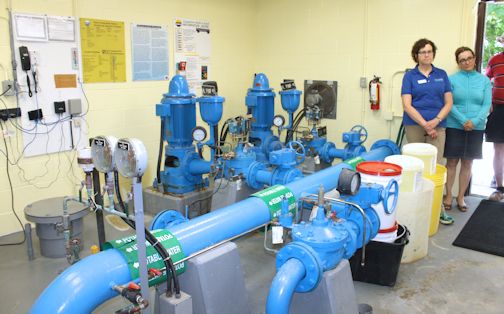
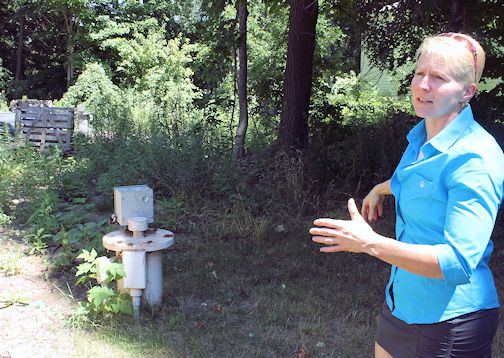
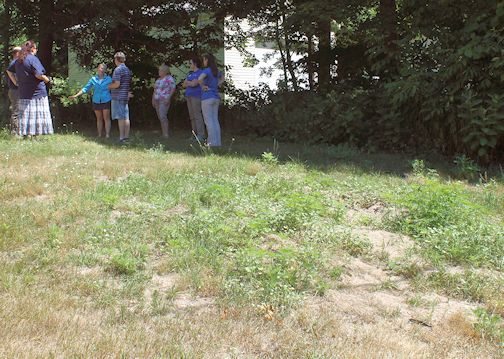
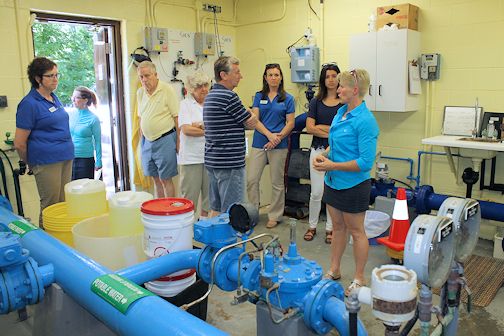
The public was then invited to take a tour of the municipal wells and pumping station on Tuscadora Road in Point Clark.
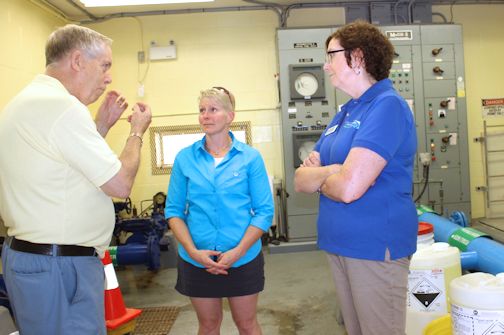
Nancy Mayhew, water operator with Veolia, pointed out the two well heads, just east of the pumphouse - the original well is located to the south and has been abandoned.
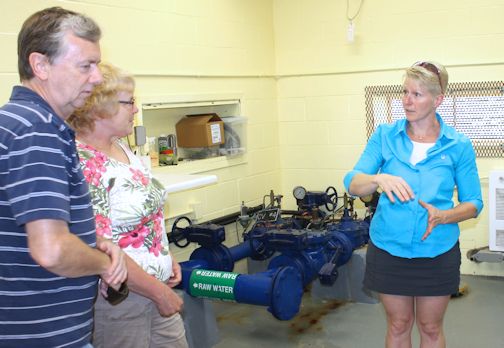
Inside the pumphouse, she showed how the raw water is piped in and then treated, before being pumped into a reservoir (beneath the pumphouse), the water tower and the distribution system. A computer system monitors everything and records it. Water sampling is done once per week, and sent to a laboratory in Niagara-on-the-Lake for testing.
"There are a lot of safety features built into this system," said Mayhew. "And the province inspects the system once a year."
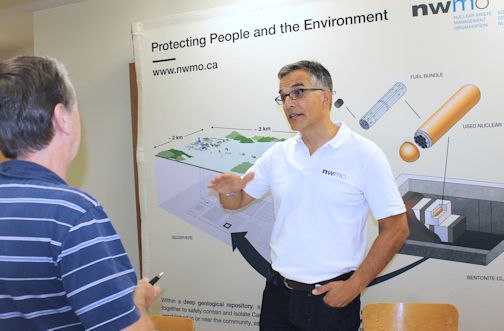
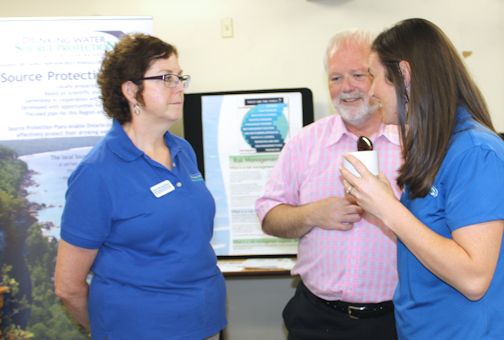
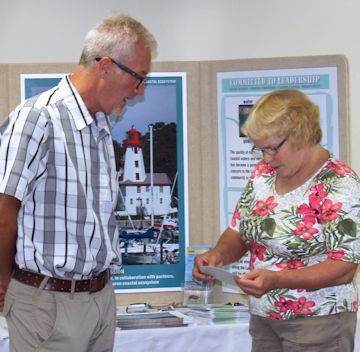
Earlier in the day, the public was invited to check out numerous exhibitors in the basement of the Point Clark Community Centre, including the Nuclear Waste Management Organization (NWMO), the Lake Huron Centre for Coastal Conservation, Drinking Water Source Protection - Ausable Bayfield Maitland Valley Source Protection Region, B.M. Ross and Associates, and Huron-Kinloss Township.
 Written By
Liz Dadson is the founder and editor of the Kincardine Record and has been in the news business since 1986.




Related Stories
No related stories.