Well-known journalist, columnist Dr. Gwynne Dyer to speak at KDSS
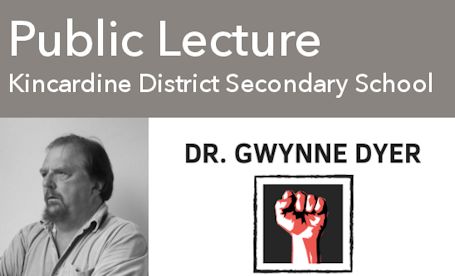
Dr. Gwynne Dyer (above), a well-known journalist and international affairs columnist, will be speaking at Kincardine District Secondary School, Tuesday, April 30.
He will be talking to senior students during the day, and giving a public lecture in the evening, from 7-9 p.m., with entrance by donation.
In the morning and evening, he will be speaking about the rise of populism; and in the afternoon, he will discuss the climate wars. During the daytime sessions, he will be addressing students in Watson Morris' Grade 12 philosophy class, and Amy Snobelen's world issues class.
Born in Canada, Dyer has worked as a freelance journalist, columnist, broadcaster and lecturer on international affairs for more than 20 years, but was originally trained as an historian. He received degrees from Canadian, American and British universities, finishing with a Ph.D. in Military and Middle Eastern History from the University of London, England.
He served in three navies and held academic appointments at the Royal Military Academy Sandhurst and Oxford University before launching his twice-weekly column on international affairs, which is published by more than 175 papers in 45 countries.
Dyer has written several books, with his most recent one, “Growing Pains: The Future of Democracy (and Work),” published in Canada and the United States in spring, 2018.
He lives in London, England; and in 2010, he was made an officer of the Order of Canada.
In his lecture, “The Trump Era: Surviving the Populist Wave,” Dyer states that Nationalism is back, and it's very angry.
“Populists have already come to power in four major countries - the United States, Britain, Italy and Brazil - and some people even fear that we are seeing a re-run of the 1930s. We all know how that ended.
“In both Europe and North America, the most visible driver of the populist revolution is immigration, which fuels a racist panic about 'identity.' But it's the rapid fall in the number of 'good' jobs over the past quarter-century that has made people anxious, angry, and vulnerable to the lure of the populists in the first place.”
Dyer states that the key votes that carried Donald Trump into the White House in the 2016 election came from the Rust Belt, where automation started destroying assembly-line jobs 25 years ago.
“Some of those voters never worked again, others move from one minimum-wage job to another - and their children try to survive in the 'gig economy.' Like the skilled weavers and artisans displaced by steam-powered machines 200 years ago, they feel betrayed and abandoned.
“The populists offer them phony hope and fake solutions, but they can’t 'bring the jobs back.' Neither Trump nor anybody else can stop the automation, and there is a plausible forecast that it will destroy 47 per cent of existing American jobs by 2033. The same thing is happening elsewhere at a somewhat slower pace. The main political task for the next generation will therefore be to ensure that those without work have an income they can live on, and don’t lose their self-respect.”
In his lecture, “The Climate Horizon,” Dyer states that when you talk to the people at the sharp end of the climate business, there is an air of suppressed panic in many of the conversations.
“We are not going to get through this without taking a lot of casualties, if we get through it at all. Every country in the world has pledged never to allow the rise in the average global temperature to exceed two degrees Celsius, but we are probably going to pass right through the two-degree limit. 450 parts per million (ppm) of carbon dioxide in the atmosphere will give us plus-two degrees Celsius, and we are already at 400 ppm.
“Plus-two degrees is the point of no return, because at that point we hit the 'feedbacks.' These are irreversible natural processes, triggered by the warming we have already created, that will also cause global warming: an ice-free Arctic Ocean, the melting of the permafrost, and immense releases of carbon dioxide from the warming oceans.
“Once the feedbacks kick in, we lose control of the process. After that, we could reduce human greenhouse-gas emissions to zero and find that the warming is still heading for plus-five or -six degrees Celsius. That would mean mass death.”
 Written By
Liz Dadson is the founder and editor of the Kincardine Record and has been in the news business since 1986.



Related Stories
No related stories.