Ripley 4-H Vet Club learns about bio-security
The Ripley 4-H Vet Club held its first meeting Thursday (July 11) at the home of Dr. Ken Bridge. New members were welcomed, as well as returning members. Once introductions were made, the club got down to business.
The members held an election for the roles of president and vice-president. Other roles, such as secretary and press reporter were acclaimed.
After members took turns reading the bio-security hand-out, they discussed contagious diseases. There are diseases in animals (especially in pigs) that wipe out most, if not all, of the animals in the herd. To avoid infection, farms use bio-security.
“
Bio- security is the practice of preventing or reducing the spread and infection of disease.” – 4-H Ontario
Bio- security practices can range from changing footwear before entering the barn, to showering with a complete change of clothes and disinfecting all items before entering the barn.
Some diseases are quite challenging to avoid, because they live in the wild, or can survive without a host (an animal that can carry the disease) for a long time. Porcine Reproductive and Respiratory Syndrome (PRRS) can survive on vehicle tires for over a year.
Other diseases are transmitted through the air. Foot and Mouth Disease or FMD can travel more than 100 kilometres in three hours, downwind.
Vaccines help protect against some diseases but there are other diseases that cannot be vaccinated against. For example, Caprine arthritis encephalitis or CAE is an untreatable goat virus that is spread through body fluids. It causes joints to become swollen and painful, meningitis, udders that are hard, hot and painful, pneumonia and progressive weight loss.
While it cannot be passed to humans, it will ultimately cause the death of the goat. Due to the fact that the virus lives inside the white blood cell, a vaccine will not work. The only way to prevent the disease is through bio-security.
The club members discussed what bio-security measures they take on their farms. The most common measure was quarantine.
One of the easiest ways for diseases to enter a herd is with the introduction of new animals from other farms. New animals are often placed in quarantine to make sure they are disease-free. Once the animals are cleared, they enter the main herd. Quarantine can last for days or months, depending on the farm's protocol.
The meeting ended and after a quick snack, everyone went home. The club thanks Dr. Ken Bridge for hosting the meeting and supplying the snack.
The next meeting is July 17, and new members are welcome.
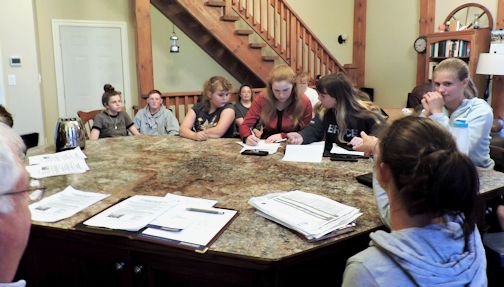 The Ripley 4-H Vet Club holds its first meeting at the home of Dr. Ken Bridge; photo by Katrina Michel
 Written By
No bio for this author.



Related Stories
No related stories.