Crowd learns about coastal processes and more at Lake Huron Nearshore Workshop
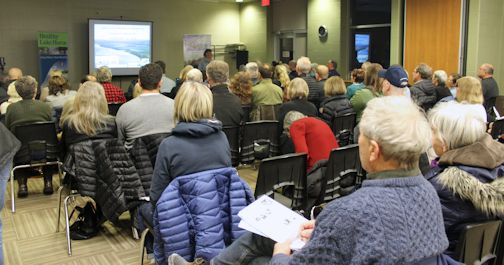
More than 70 people gathered Tuesday night at the Davidson Centre in Kincardine, for the Lake Huron Nearshore Workshop, a free public seminar, co-hosted by the Saugeen Valley Conservation Authority (SVCA) and the Lake Huron Centre for Coastal Conservation, supported by Environment and Climate Change Canada
The event comprised a series of four presentations, addressing coastal processes (how the lake and shoreline interact); issues of concern particularly of erosion potential solutions for landowners;and the role and scope of conservation authority regulations.
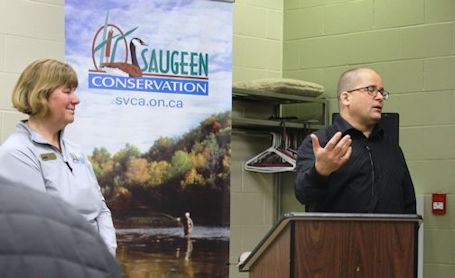
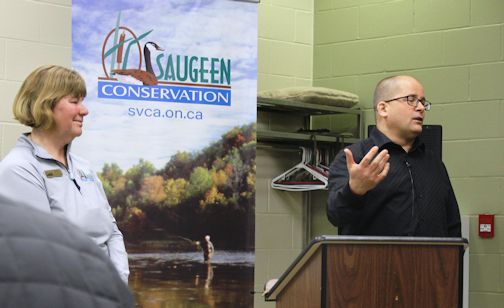
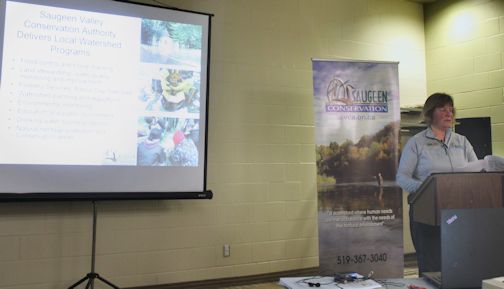
The crowd was welcomed by Jo-Anne Harbinson, SVCA manager, water resources and stewardship services, who introduced each speaker, beginning with Robin Davidson-Arnott, professor emeritus at the department of geography, environment and geomatics at the University of Guelph.
His presentation covered the post-glacial evolution of the Great Lakes Basin, describing how land recovers following the retreat of a glacier and the many historical changes that ultimately resulted in the current configuration of the lakes.
He then described the input/output factors that influence lake levels, such as precipitation versus evaporation, and the difficulty of regulating water levels in the Great Lakes with reference to research conducted by the International Joint Commission Upper Great Lakes Study.
The topic of coastal processes and sandy beaches was of particular interest to participants who learned how variables of wind speed, duration and fetch (the distance a wave can travel) affect the potentially-destructive force of waves on the shoreline. Dune systems and their interaction with the beach were also explained as dynamic cycles of withdrawal and deposit.
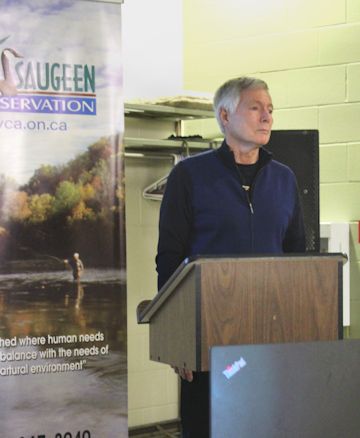
The next speaker, Pete Zuzek, addressed shoreline erosion and adaptation strategies. Zuzek is an experienced coastal geoscientist consultant who specializes in helping manage the complexities of coastal erosion, shoreline management, development and restoration, among a host of other coastal issues.
Using examples taken largely from work on the north shores of Lakes Erie and Ontario, he explained how hardening a shoreline changes the lake’s ability to recover and may actually worsen the problem being addressed.
He believes that climate change will result in greater extremes in water levels and wave energy which will increase erosion rates. He also believes that current adaptive strategies are largely insufficient and in some cases, prohibitively costly.
The third speaker, Hannah Cann, coastal stewardship co-ordinator at the coastal centre, focused on eco-friendly options for protecting the shoreline versus man-made hardened structures.
Natural methods, which encourage growth of vegetation and restoration of dune systems, provide the ecological benefits of greater biodiversity, water filtration and carbon capture, as well as economic benefits since they cost little compared to shoreline hardening methods which are costly, require maintenance and can change the way sediments move, resulting in changes to the ecosystem, as well as expediting the erosion of neighbouring properties.
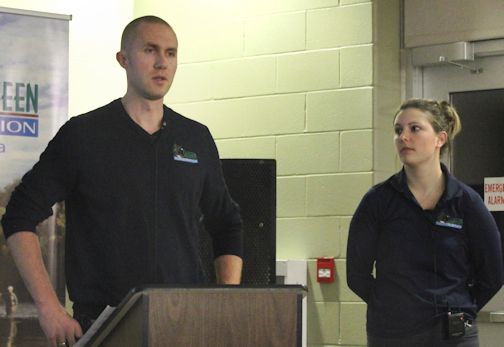
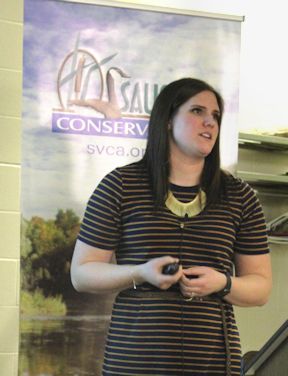
The fourth and final presentation was made jointly by Erik Downing, SVCA manager, environmental planning and regulations, and Elise MacLeod, SVCA regulations officer, who sought to help participants better understand SVCA regulations pertaining to the Lake Huron shoreline.
Acknowledging the frustration of shoreline property owners who seek to protect their property and structures in the face of high water levels, Downing emphasized conservation authorities’ mandate to protect people and property and conserve local ecosystems.
The regulations are designed to protect the subject property as well as neighbouring properties and the cumulative impact along the shoreline. The conditions under which approval is required and the steps to requesting and obtaining approval were outlined.
Although some attendees may have been disappointed by a lack of easily-applied solutions to the problem of erosion, thanks to an excellent panel of speakers, everyone left the meeting with a better understanding of coastal processes and appreciation for the complexities of the challenges facing the Lake Huron shoreline.
 Written By
No bio for this author.



Related Stories
No related stories.