Province seeking input on how personal information is collected, used, safeguarded
The Ontario government has launched consultations to improve the province's privacy protection laws.
People and businesses from a wide range of sectors, including technology, financial and service, and the Information and Privacy Commissioner of Ontario, will have the opportunity to contribute to strengthening transparency and accountability, concerning the collection, use and safeguarding of personal information on-line.
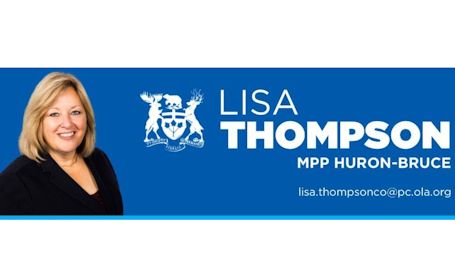
"Our government continually hears concerns regarding the province's privacy protections," says Huron-Bruce MPP Lisa Thompson, whose ministry of government and consumer services launched the consultations.
"This has only been further highlighted during the COVID-19 (Coronavirus) outbreak, which has resulted in Ontarians relying more on digital platforms to carry out day-to-day tasks,” she says. “With the increased reliance on these platforms, there is a strong need to build public and consumer confidence and trust in the digital economy. As we are empowered by technology and the evolving digital landscape, never before has privacy been more important."
Through an
on-line survey, written submissions and web conferences, the government is collaborating with the people of Ontario to create a legislative framework for privacy in the province's private sector.
“I encourage all Ontarians to participate in these consultations as privacy is critically important to everyone," says Thompson.
The province is seeking advice on ways to:
- Increase transparency for individuals, providing Ontarians with more detail about how their information is being used by businesses and organizations.
- Enhance consent provisions, allowing individuals to revoke consent at any time, and adopting an "opt-in" model for secondary uses of their information.
- Introduce a right for individuals to request information related to them be deleted, subject to limitations (this is otherwise known as "right to erasure" or "the right to be forgotten").
- Introduce a right for individuals to obtain their data in a standard and portable digital format, giving them greater freedom to change service providers without losing their data (this is known as "data portability").
- Increase enforcement powers for the Information and Privacy Commissioner to ensure businesses comply with the law, including giving the commissioner the ability to impose penalties.
- Introduce requirements for data that has been de-identified and derived from personal information to provide clarity of applicability of privacy protections.
- Expand the scope and application of the law to include non-commercial organizations, including not-for-profits, charities, trade unions and political parties.
- Create a legislative framework to enable the establishment of data trusts for privacy protective data sharing.
"As Ontario transitions to the post-COVID realities, the global, data-driven economy continues to march ahead presenting new challenges for policy makers," says Benjamin Bergen, executive director of the Council of Canadian Innovators. "Our members welcome the government's effort to design a new and updated framework that allows it to govern the economic and non-economic effects of the data-driven world where the collection, use and monetizing of personal data is at the centre of new business models.
“Privacy protections and industry growth don't need to be at odds and we look forward to the discussion on how best to enhance fundamental personal privacy elements while positioning Ontario to be a leader in the 21st Century innovation economy."
Written submissions from impacted businesses and the public will be accepted until Oct. 1. Anyone can participate in the consultation by filling out the
on-line survey.
Quick Facts
- The 2019 Ontario Budget announced a digital plan, including introduction of the Simpler, Faster, Better Services Act, designed to significantly improve how government works and the services it delivers to people and businesses across Ontario.
- Through the Digital First plan, the government is putting several transactions at ServiceOntario on-line, enabling Ontarians who need to renew their driver’s licence, licence plate sticker or health card, the ability to do so conveniently, error-free and with ease.
- Currently, private sector organizations operating in Ontario must follow the rules set out in the Personal Information Protection and Electronic Documents Act which governs traditional commercial activities.
- A data trust is a legal mechanism that enables an organization’s data to be governed by a trusted third party, to ensure the transparent and accountable use of that data. It operates under legal agreements that follow existing intellectual property and privacy protection laws. Currently, no jurisdiction in Canada has a legislative framework for data trusts.
 Written By
No bio for this author.



Related Stories
No related stories.