South Bruce CLC hears from analyst at Canadian Nuclear Laboratories
At the October virtual meeting of the South Bruce Community Liaison Committee (CLC), the guest speaker was
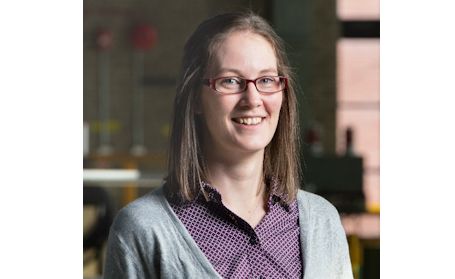
Megan Moore (above), an operations research analyst at the Canadian Nuclear Laboratories (CNL), Canada’s largest science and technology laboratory.
Moore contributes to many projects which look at the potential impacts of Small Modular Reactors (SMRs). In 2016, she was one of the lead scientists working on the feasibility study on recycling CANDU fuel.
Her presentation at the CLC meeting Oct. 8, looked at the results of that study and some of the challenges that were identified.
At the outset, Moore explained that the study took place in response to a request from the Ontario Ministry of Energy.
She provided a breakdown of what components make up used CANDU fuel, and then outlined the three options for fuel-recycling that were analyzed in the study – recycle it back into CANDU reactors, recycle it into large sodium-cooled fast reactors, or recycle it into small metal-fuelled burner fast reactors.
The evaluation criteria used for the analysis, were also presented; they fell into eight categories:
- Environmental
- Safety and licensing
- Sustainability
- Non-proliferation
- Community and social considerations
- Costs
- Waste disposal
- Economic impact
Some of the main challenges that Moore showed in the results of the study were in regard to the costs associated with the reprocessing. Additionally, the study concluded that the requirement for further technology development, as well as safety and security guidelines for fuel reprocessing, is still needed.
Following her presentation, questions were asked by several CLC members. Member Brian Knox inquired as to who funds the CNL. Moore responded that the CNL is currently government-owned and contract-operated; in short, the government owns the facilities, but the employees work for the contractors.
Viewers from the public – of which there were approximately 34 who joined, via Zoom – were also able to ask questions, using a virtual Q & A function.
One viewer asked if there was scope for co-operating with France – which has been recycling used fuel for decades – in order to ramp up recycling in Canada.
Moore stated that this would certainly be possible, and there would be an interest in collaborating internationally if recycling were pursued here even though there are some differences in our fuel composition.
Another community member asked Moore if she believed that in several decades technology would allow for the recycling of most of the waste in a Deep Geological Repository (DGR), and if so, would the cost of constructing a DGR still be worthwhile.
Moore acknowledged that there is certainly the opportunity to recycle in the future and she recognizes that the Nuclear Waste Management Organization (NWMO) is planning to ensure that the nuclear waste in a DGR would be retrievable.
“However, we will still need a DGR at the end if we are recycling or not,” remarked Moore. She added that the establishment of a DGR would, thus, still be worthwhile, in her opinion.
The slide-show used during Moore’s presentation can be found on-line in the CLC’s October agenda package at:
clcinfo.ca/southbruce/meetings/.
Each month, the CLC welcomes educational presentations at its meetings, to discuss particular subject matter and offer knowledge in relation to the NWMO’s Adaptive Phased Management site-selection process.
The November meeting of the CLC will welcome Dr. Gordon Edwards, a mathematician by career, and an adjunct professor of science and human affairs at Concordia University. He has been active on issues surrounding radioactive waste for more than 45 years, has given workshops around the world on this subject and has presented to other CLCs previously. This meeting will be held Nov. 5, at 7 p.m., via Zoom and over the phone.
 Written By
No bio for this author.



Related Stories
No related stories.